

The Seashell Meme: When Thin Skin Meets Thin Law
How a childish meme became a test of the First Amendment

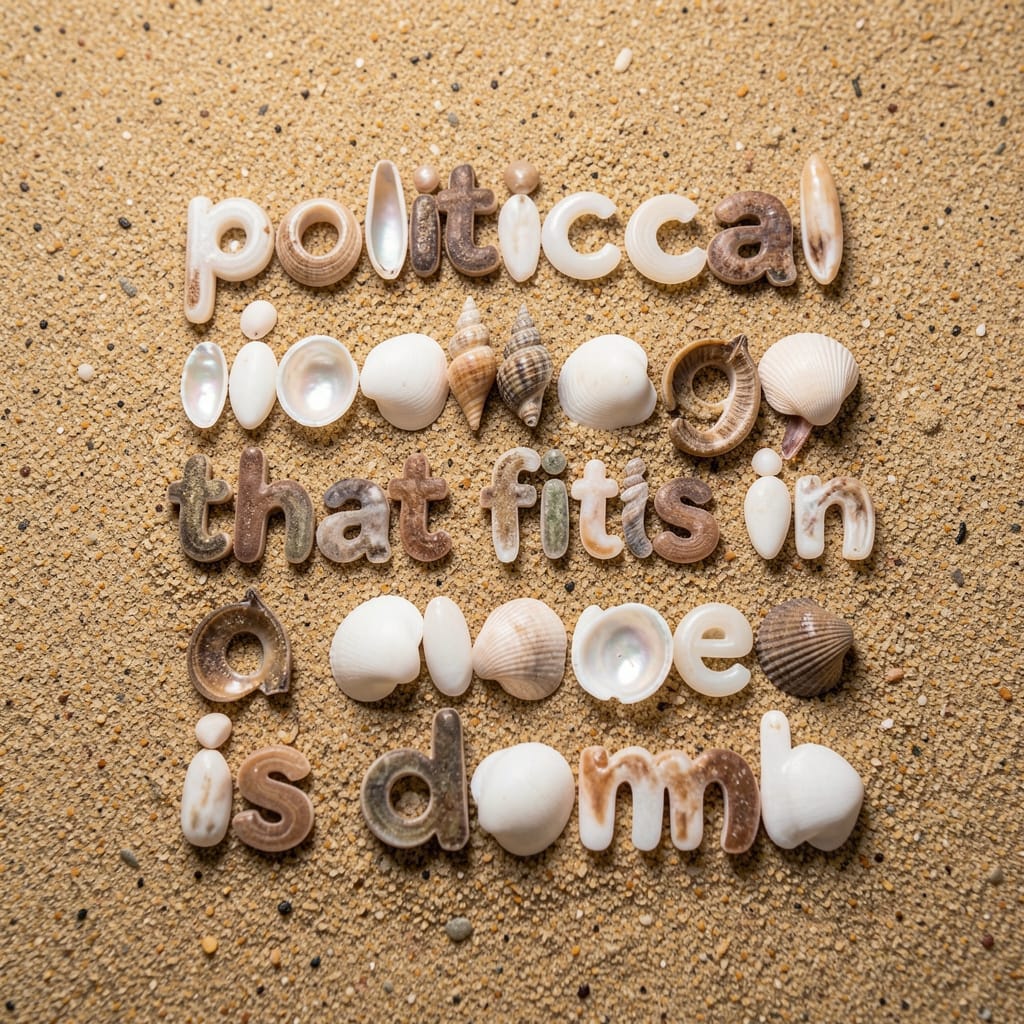
Prosecuting James Comey over the “86 47” seashell photo is constitutionally flimsy, politically foolish, and dangerous to any coherent notion of what a “reasonable person” can be expected to infer from political speech. The case only really comes into focus when you see how the First Amendment is being bent around one man’s thin skin.
A Seashell Meme on Trial
James Comey’s now‑infamous post is, in isolation, almost comically a non-issue: a photo of seashells arranged as “86 47,” paired with a bland caption about a beach walk. Online, the meaning was instantly decoded as an anti‑Trump slogan - “86” as “get rid of,” “47” as Trump’s presidential number - not as a mob contract. It was the sort of thing that fits naturally into the resistance‑meme ecosystem: glib, deniable, and more about social alignment than persuasion.
None of that makes it admirable. This is a former FBI Director who has spent the last decade as a central character in Trump‑world cosmology, not an anonymous poster in a group chat. In that context, composing a coy “86 47” tableau out of seashells is less high principle than midlife Twitter brain - trolling for its own sake, calibrated to be legible to your friends and infuriating to your enemies.
It is juvenile politics.
And it is absolutely protected speech.
Comey eventually took the post down and said he opposed violence, that he understood it as a political message, and that he had not appreciated that some people read “86” as a literal call for harm. Even on that telling, it is a dumb decision by a very sophisticated person. But “dumb” is not a crime category, and it certainly isn’t a freestanding exception to the First Amendment.
How True‑Threat Law Is Supposed to Work
That distinction between “dumb” and “criminal” is where the law is supposed to help. In modern First Amendment doctrine, “true threats” sit outside constitutional protection, but the bar is intentionally high. To put someone in prison for their words, the government has to show not just that someone, somewhere, could feel afraid, but that the speaker knowingly conveyed, or consciously disregarded the risk of conveying, a serious expression of intent to commit violence.
In plainer terms, it’s not enough that your speech could be misread by an anxious recipient. The question is whether you meant to threaten, or at least were clearly playing with fire in a way any ordinary person would understand as threatening. That’s why courts draw distinctions between someone yelling a specific violent plan at a named person and someone saying, in the abstract, that a president “should be taken out” in the context of policy criticism or elections.
The Comey indictment blows through that guardrail. It leans hard on the language of a “reasonable recipient” but then quietly swaps in “politically paranoid observer” as the benchmark. If the most feverish reading of a cryptic meme becomes the legal standard, the category of “true threat” will swallow an enormous amount of normal, if ugly, political speech. Think about how much of our rhetoric depends on metaphorical violence: “fight back,” “take him out,” “we’re going to destroy them.” If that lexicon is enough to get you indicted whenever the wrong person is listening, nobody who does politics in public is safe.
That’s what makes the case not just weak, but dangerous.
If a shell arrangement that only resolves into “kill the president” after you’ve marinated in Trump’s grievances for eight years can be prosecuted as a felony, then the line between dissent and threat is whatever the White House says it is. And flexible lines do not stay in one party’s hands for long.
Comey’s Childishness, Trump’s Obsession
None of this should be mistaken for a defense of Comey’s judgment. There is something fundamentally unserious about a former FBI Director washing his hands of institutional authority while still bathing in its aura, posting “86 47” as if he’s a guy in the cheap seats rather than someone who helped shape the stage. If you have been explicitly cast as part of the deep‑state conspiracy to destroy a president, you know exactly how a winking beach meme is going to land.
Call it the resistance version of what Trump does every day: dressing personal animus up as performative courage. It’s not especially brave to “poke the bear” when you also get to bask in the online applause for poking the bear. It is childish, and in a healthier political culture, it would be called that from every direction. We would be capable of saying, at the same time, “this is stupid” and “this is protected.”
But Trump’s response is its own kind of childish, just weaponized. He has insisted that Comey “knew full well” that “86” is a mob term for “kill,” and he has talked about the post as if it were essentially a mob signal to would‑be assassins. Instead of waving off a petty provocation, he fixated on it, folded it into his familiar story about being under siege, and then watched as the machinery of federal prosecution was pointed at it.
That is the fusion point between temperament and doctrine. Thin skin, when attached to a private citizen, is a personality flaw. Thin skin, when attached to a president with a friendly Justice Department, becomes a flimsy barometer of what is criminal. The worst‑faith reading of your critic’s speech is suddenly not just a talking point but evidence.
When the Presidency Becomes a Feelings Machine
This is where the Comey case stops being about one Instagram post and starts being about what the presidency is for. If the office has become a feelings machine - an engine for processing and punishing every perceived slight - then of course a seashell meme must be elevated into an existential threat. It cannot simply be a dumb joke; it has to be proof that They are out to get Him.
You can see this dynamic in the broader pattern. Public polling now routinely finds that only a minority of Americans describe Trump as “even‑tempered,” and large majorities express concern about his temperament, emotional volatility, and outbursts. A separate slice of surveys shows that many voters think he is using the justice system to go after “enemies” rather than neutrally enforcing the law. The Comey indictment slots neatly into those pre‑existing perceptions: yet another data point suggesting that the machinery of state is being bent around the emotional life of the president.
That fusion is poisonous for both law and politics. Legally, it erodes the distinction between “I feel threatened” and “this is a true threat.” It asks prosecutors and agents to treat the president’s personal sense of grievance as a proxy for the public’s safety. Politically, it reinforces exactly the narrative that worries his soft supporters and persuadable voters: the sense that Trump is simply unable to absorb criticism without trying to hit back with whatever institution he can reach.
And this is where Comey’s immaturity and Trump’s obsession feed each other.
The more figures like Comey engage in snickering, personalized symbolism - “86 47” shells, clever captions, all the dopamine of being part of the club - the easier it is for Trump to claim persecution and justify punitive responses.
The more Trump turns those responses into actual prosecutions, the more oxygen he gives to the idea that the only way to oppose him is through mockery and coded jabs, because normal politics clearly isn’t working.
Futility, and the Costs of Making a Meme a Felony
What does the White House actually gain from criminally charging a former FBI Director over a dumb Instagram post? In any plausible scenario, Comey emerges either acquitted or with a conviction that will be a prime candidate for appellate reversal on First Amendment grounds. The legal precedent is, at best, unstable. The signal sent to future administrations - that they can stretch “true threat” doctrine around their own enemies - is much more durable.
Meanwhile, every news cycle spent on “Trump versus the seashells” is a news cycle about his volatility and his obsession with enemies. Even voters who have no affection for Comey, and no patience for resistance kitsch, can tell the difference between “he shouldn’t have posted that” and “he should go to prison for it.” The more the president blurs that line, the more he confirms that basic fear: that his personal resentments are indistinguishable from his theory of justice.
That’s why the prosecution is not just wrong but futile. It will not deter future trolling; it will mint martyrs and spawn more memes. It will not meaningfully reduce the risk of violence; it will teach future presidents that they can launder their hurt feelings through the vocabulary of security. And it will not, in the long run, strengthen Trump’s hold on the electorate; it will push more people into the uneasy, but increasingly familiar, conclusion that whatever they think about his policies, the man himself is not stable enough to be trusted with this much power.
The seashells, in other words, are trivial. The reaction to them is not. When a democracy starts treating juvenile political taunts as criminal threats because the president cannot bear to be mocked, the problem is not just constitutional or just psychological. It is both, and you cannot fix one without being honest about the other.